


It has been a loud week. The ESRI confirmed that one in five people in employment in Ireland is a non-Irish citizen.1 Within hours, that figure was being used to argue that work permits are now for “unskilled” jobs and that Irish workers are being left behind.5 At the same time, people living and working here were being told that a citizenship proposal will shut them out, price them out, or worse.
We arrange employment permits every week, for employers across Ireland and the UK, and we test every candidate on the tools before an employer sees a CV. So here are the facts, from the official documents and the Department’s own figures, with every source numbered at the end so you can check them yourself.
What the ESRI actually found
The ESRI and the European Migration Network published Non-EEA migration to Ireland in times of labour and skills shortages, by Ada Sophia Hahn and Dervla Potter, on 3 November.1 It was reported the same day by Ailbhe Conneely for RTÉ,3 Emmet Malone for the Irish Times4 and Eoghan Dalton for TheJournal.17 In short:
- Between 30,000 and 40,000 employment permits were issued or renewed in each of the last four years.2
- 8,328 companies recruited from outside the EEA in 2025, and more than half of them took on just one person.2
- The shortages are in health, social care, construction, ICT, agri-food and transport.2
- Retention is low, especially among the most highly skilled.2 The Irish Times reports that 40% of Critical Skills permit holders have left after two years.4
That is not a picture of a country being overrun. It is thousands of ordinary businesses, most of them small, filling one or two jobs they could not fill locally, and then struggling to hold on to the people they brought in.
Seventeen years of Irish hiring, open to everyone
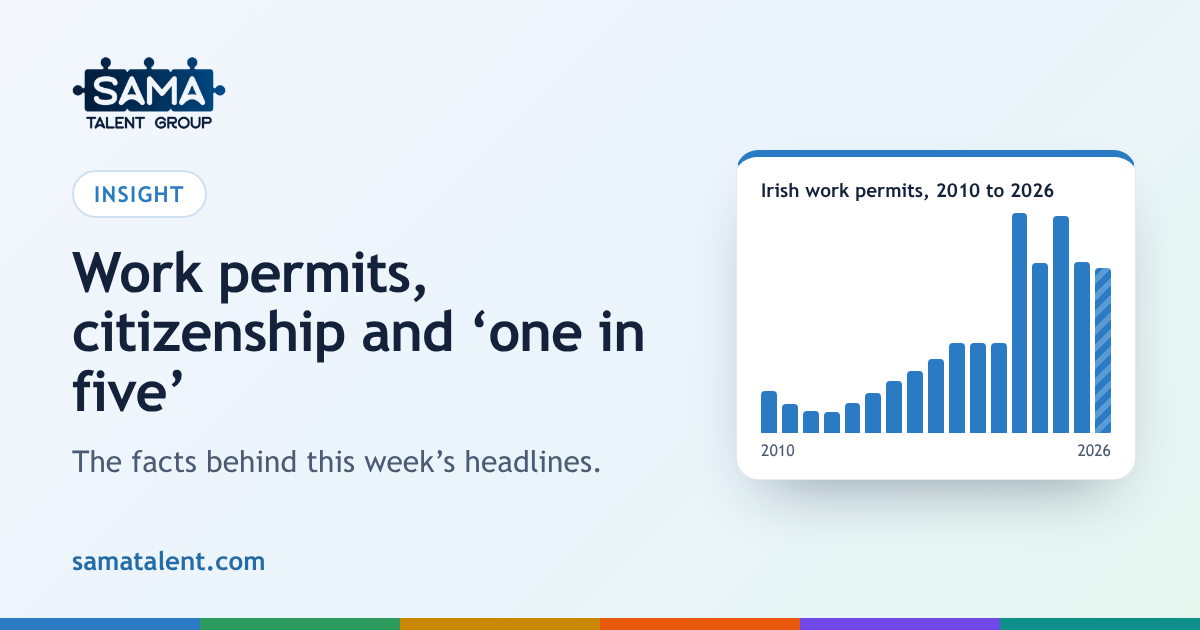
You don’t have to take anyone’s word for any of this, including ours. The Department of Enterprise, Tourism and Employment publishes its employment permit figures,16 and we have laid every year of them out so anyone can search them: by county, by sector, by month and by employer.
Employment permits issued in Ireland, 2010 to 2026
2026 is January to September. Source: DETE employment permit statistics,16 as laid out on our permit figures page.
Look up any business in the employer directory or with the employer permit check. See who hires most in the top 100, who is growing fastest in fastest growing, who hired from abroad for the first time in new this year, and who stopped in gone quiet. The monthly Permit Pulse and the Q3 2026 report pull it together, and hiring in your area breaks it down county by county.
What you’ll find is hauliers, garages, engineering firms, farms, hospitals and nursing homes. Businesses that advertised a job, waited, and nobody came.
Claim one: “permits are now for unskilled jobs”
The ESRI found that in 2024, for the first time since 2016, slightly more General Employment Permits were issued than Critical Skills permits.2 Some have read “general” as “unskilled”. It isn’t.
The General Employment Permit is the route for skilled trades that are not on the Critical Skills list.6 That includes welders, HGV and bus mechanics, panel beaters and body repairers, drivers holding a CE or C1E licence, and qualified chefs at set levels of experience.10 These trades take years to learn, and every one of them is short of people in motor workshops, fabrication shops and haulage yards around the country. Our permit occupation check shows where any job sits on the official lists.
The permit also carries a pay floor. Since 1 March 2026 the minimum salary for a General Employment Permit is €36,605 a year.8 It is not a route to cheap labour, and most trades pay well above it, as our 2026 pay guide shows.
Claim two: “Irish workers are being left behind”
Before a General Employment Permit can be granted, the employer has to run the Labour Market Needs Test.7 The job must be advertised for at least 28 days in a row on JobsIreland and the EURES network, and on a second online platform. Only when nobody suitable from Ireland or the rest of the EEA comes forward can the employer apply. We have written up how the test works in practice.
On top of that, at least half of the employer’s staff must be Irish or EEA nationals at the time of the application. That is the 50:50 rule.6 So nobody is skipped. The local market is tried first, by law, every time.
Claim three: “employers just want to hire their own”
The rules don’t care who owns the business. The same 28-day advertising test and the same 50:50 rule apply to a family workshop in Mayo and a multinational in Dublin.6 7 And none of it is hidden: every employer holding permits is in the Department’s figures, and in our directory, by name.
The citizenship proposal: what is in it, and what isn’t
The other story this week was the protest at Leinster House over the Government’s plans for citizenship, reported by Louise Burne in the Irish Examiner and James Cox in the Irish Times.11 12 People are worried, and some of what is being said is making that worse, from both directions. Here is what the document itself says.
The proposal is the General Scheme of the Irish Nationality and Citizenship (Amendment) Bill 2026, published by the Department of Justice, Home Affairs and Migration on 21 September.9 A general scheme is an outline of a future Bill. It is not law. It still has to go through pre-legislative scrutiny at the Oireachtas Justice Committee, then be drafted and pass the Dáil and Seanad. No start date has been set.
What the scheme proposes9
- Residence: eight years in total (two years continuous, plus six of the ten years before that), up from five.
- Language: proficiency in English, Irish or Irish Sign Language. The level and the type of test are not in the scheme; the Minister would set them later.
- Civics: knowledge of Irish civics, the standard again left to the Minister.
- Income: a minimum income, with no figure published.
- Welfare and housing supports: a bar on certain payments and supports, such as HAP, in the two years before applying and while the application is processed, with discretion where the support adds up to no more than six months in those two years.
What it does not do: it does not change how employment permits are granted, and it does not touch anyone’s right to live and work here on their current permission. It is about citizenship, a separate step that comes years after a person arrives.
So some of what has been said this week doesn’t stand up. It is not “already law”. Nobody yet knows whether a healthcare assistant or a meat plant worker will meet the income test, because no figure has been set.11 Minister Jim O’Callaghan calls citizenship “a privilege, not a right”;14 the Migrant Rights Centre Ireland says the plans follow “the most restrictive countries in Europe”.13 Both are entitled to make that case. But eight years is a long wait, and the details that matter most, the income figure and the language level, are still to be decided. That is why the committee stage matters. If you are thinking about applying, get advice on your own case from a solicitor.
Whatever language level is eventually set, it helps to know where you stand. Our free English mock test covers reading, writing, listening and speaking, and marks them straight away.
The real problem: keeping people
Strip away the noise and the ESRI’s biggest worry is not too many workers arriving. It is that Ireland can’t keep them.2 RTÉ also reported that many permit holders don’t know the protections they already have,3 such as the right to change employer after nine months.15 Those rights are set out in plain English in our guide to your rights at work in Ireland.
That matches what we see. The job is rarely the hard part. The hard part is everything around it:
The rules of the roadPractice tests for Ireland, the UK and drivers’ hours
What a wage leaves youRent, bills and food, county by county
The first fortnightSettling in, area by area
Ireland knows this story from the other side. Generations of Irish people built lives in Britain, America and Australia because those countries let them work and helped them settle. Getting the settling-in part right is how a worker stays, and how a community gets a neighbour rather than a stranger.
Where to go from here
Coming to work here?
Everything above is free, with no sign-up, at samatalent.com/learn. The skills checks give you a certificate an employer can verify, the CV builder puts it on one page, and here is what happens at a trade test. When you’re ready, see the jobs open now.
Hiring?
Start with how hiring from abroad works in Ireland or the UK, and what to plan before your first hire arrives. Choosing who to work with? These are the ten questions to ask any agency.
Sama Talent Group is a licensed Irish employment agency (EA 5649) placing skilled trades, drivers and engineers in Ireland and the UK. Councils, community groups and training centres working with people new to Ireland: tell us what else would help. Employers: sales@samatalent.com. Candidates: jobs@samatalent.com.
Sources
- Hahn, A.S. and Potter, D. (2026), Non-EEA migration to Ireland in times of labour and skills shortages, ESRI Research Series 243, ESRI and European Migration Network Ireland, 3 November 2026.
- ESRI, “Workers from outside the EEA play an important role in meeting Ireland’s labour and skills shortages”, press release, 3 November 2026.
- Conneely, A., “Non-Irish citizens make up one-in-five in employment in the state”, RTÉ News, 3 November 2026.
- Malone, E., “State requires large number of workers from outside European Economic Area, according to ESRI”, The Irish Times, 3 November 2026.
- Treacy, M., “Work permits increasingly for unskilled jobs: Irish left behind”, Gript, 3 November 2026. Headline and published summary only.
- Department of Enterprise, Tourism and Employment, General Employment Permit, checked 4 November 2026.
- Department of Enterprise, Tourism and Employment, Labour Market Needs Test, checked 4 November 2026.
- Department of Enterprise, Tourism and Employment, minimum annual remuneration from 1 March 2026, 2 December 2025.
- Department of Justice, Home Affairs and Migration, General Scheme of the Irish Nationality and Citizenship (Amendment) Bill 2026, 21 September 2026.
- Department of Enterprise, Tourism and Employment, Ineligible List of Occupations for Employment Permits, and the 2025 review of the occupations lists.
- Burne, L., “‘We’re being used as scapegoats’: Migrants protest proposed reform of citizenship rules”, Irish Examiner, 3 November 2026.
- Cox, J., “Proposed citizenship changes condemned at protest”, The Irish Times, 3 November 2026.
- Migrant Rights Centre Ireland, “The Unfair Game of Citizenship: Migrants rally at Leinster House against Minister’s plans”, 3 November 2026.
- Conneely, A., “Protest against citizenship changes to take place”, RTÉ News, 3 November 2026.
- Department of Enterprise, Tourism and Employment, Changing employer, checked 4 November 2026.
- Department of Enterprise, Tourism and Employment, employment permit statistics, 2010 to 2026, as compiled on samatalent.com/employers/ireland/permits.
- Dalton, E., “Demand for ‘lower-skilled’ migrant workers becoming greater than higher-skilled migrants”, TheJournal, 3 November 2026.